
by Martin Bier (25/12/2015)

Cars need gasoline and a washing machine will stop running the moment you pull the plug. This is because energy can be converted from one form to another, but it cannot be made to magically appear out of nothing. Anyone making claims about an engine running without an energy input is either a swindler or an ignoramus. The ‘Rosch Thrust Kinetic Generator’ is the most recent attempt at hyping up a ‘free energy’ engine. Common sense and a little bit of high school physics are all that is needed to show that here too the Law of Conservation of Energy stands in way.
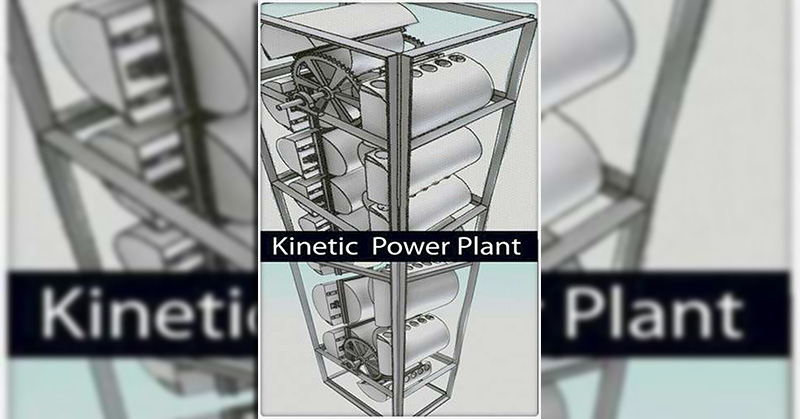
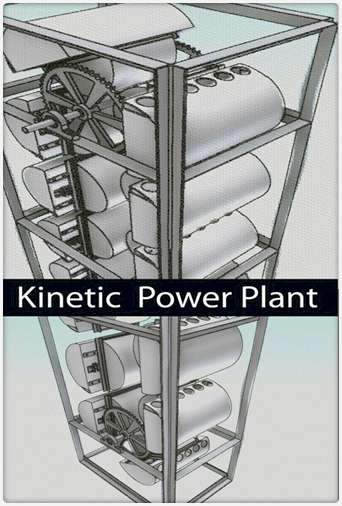
The device shown left is the Rosch Thrust Kinetic Generator. It is developed and manufactured in Serbia, but the company also has branches in Germany and in Switzerland. Google on Rosch Thrust Kinetic Generator and glossy brochures pop up, promising a bright new future (see for example the site of Zilverstroom).
How does it work? Or rather, how is it supposed to work? The entire device in the illustration above is submerged in a column of water. At the bottom on the left side of the device air bubbles are injected into the water column. These air bubbles are captured in containers. The containers are pushed upwards by the air and the engine’s chain transmission is set in motion. Once a container reaches the top of the water column, it topples and the side with the holes comes up. The injected air then escapes. The upward force only pushes up containers on the left side of the column and this is what keeps the system in motion. Combustion engines will be museum pieces. Windfarms will be mere monuments. Nuclear power will be obsolete.
Sounds too good to be true? That’s because it is. The rub is that it takes energy to pump air bubbles into the water column. The maximum amount of energy that can be extracted as the air bubbles push the containers upward equals exactly the amount of energy it takes to pump the bubbles into the water column.
What Is The Source Of The Energy?
Like everything in the universe, flowing gasses and moving liquids do not escape the Law of Energy Conservation.
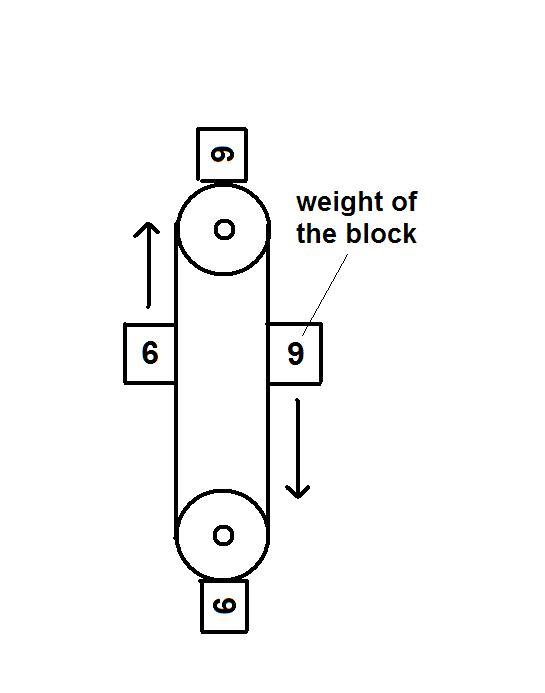
As is demonstrated with the next illustration, it requires pressure, and therefore force and energy, to insert an air bubble at the bottom of the water column.
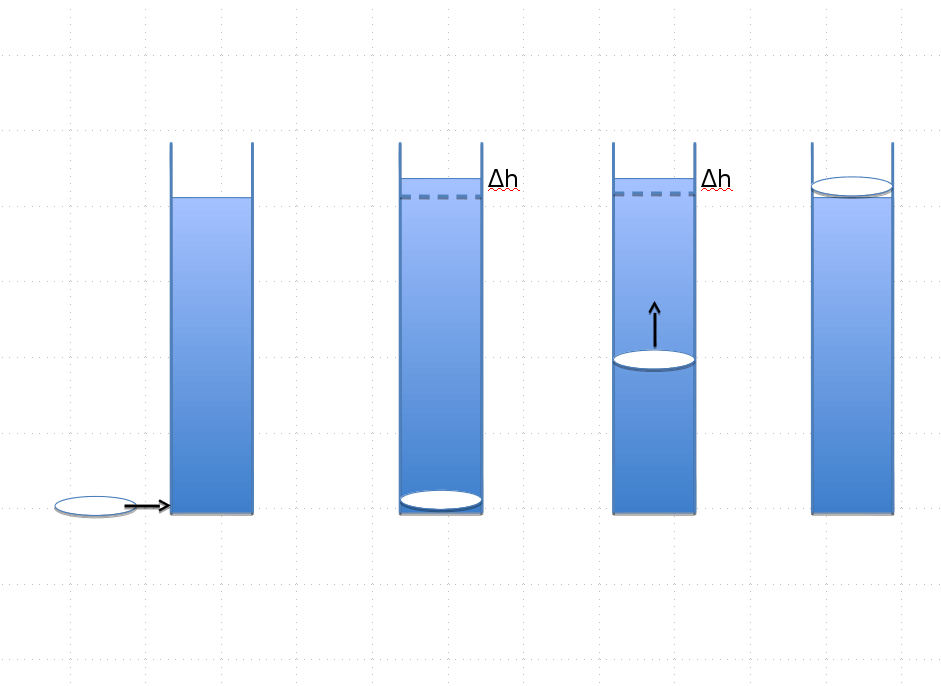
Let the mass of the water column be M. The insertion of the air bubble raises the level of the entire column by a height Δh. The energy that is necessary to do this is E = M × g × Δh, where g is the acceleration of gravity. M×g is the weight of the column of water, i.e. the force with which gravity is pulling it down. The height Δh is the distance that needs to be covered when expending energy to overcome gravity. When the inserted air bubble next moves up, the mass of water above the air bubble gets smaller and smaller. Effectively, the water is falling around the air bubble and that falling again releases the energy that was put into lifting up the entire column. When the air bubble reaches the surface and disappears, the water column is back in its original state. The Rosch Generator shown in the first figure captures the air bubbles in containers. The upward motion caused by the buoyant force is used to generate energy. In the impossible case that the device is completely frictionless and the energy conversion is 100% efficient, only in that case will the device produce exactly the amount of energy that is required to insert the air at the bottom of the column.
You can take a piece of styrofoam and push it down under water. When you next release that piece of styrofoam there, it will come to the surface. Energy can indeed be extracted from that upward motion in a way that is analogous to how a hydroelectric power plant extracts energy from falling water. However, the energy that is extracted from the upward motion of the styrofoam will never be larger than the energy it took to push the styrofoam down. If you don’t push the styrofoam straight down, but instead insert it at the bottom of the water column, you need just as much energy. This is because the water pressure that you have to work against in the insertion is directly proportional to the depth below the water surface. The second figure illustrates this.
Many “free energy” devices are boxes filled with electrical parts where it is hard to figure out what is happening or what is supposed to happen. Claiming that patent applications are still pending, the manufacturers of these devices also commonly refuse to have their devices or designs examined by outsiders. With such secrecy and vagueness it is impossible to have a meaningful discussion. But Rosch is remarkably open and forthright. The concept and the device are refreshingly simple. Because of this, we can also be short and concise when showing that it is all a mistake.
Quarter Of A Million Households
On the internet you’ll find stories about producing 100 megawatts (one hundred million watts!!!) and about how a power plant with a capacity like that can be commissioned. Apparently over at Rosch’s they think big. One hundred megawatts is roughly the at-home electrical power consumption of a quarter of a million West-European households all together. We are talking about powering a city here!
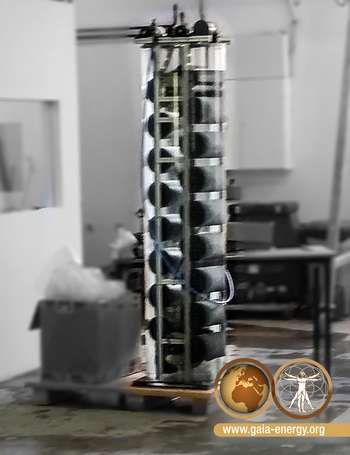
There are also smaller models for domestic use. These can be ordered in Germany from the “Verein Gaia” . The figure left is a photograph of such a model.
On the Dutch FE4ALL website (Free Energy for All) there is an almost touching description of how four members actually traveled to Germany to inspect this smaller device. But in the end frugality won the day as the quartet agreed that 15,000 euros (US$16,500) was a little too steep. Apparently even Holland’s most revolutionary innovators have to sometimes watch the pennies! But according to their website FE4All is seriously considering buying a Dutch license for the technology. Really … a license like that would be worth no more than the paper that it is printed on.
This article was originally published on the (old) Skepsis blog, where readers could engage in discussion below the article, which was regularly used extensively. Anyone interested can read the discussion below this post in this pdf (13 pages).