
Was Hippocrates a Homeopath?
Some homeopaths claim that their art goes back to Hippocrates. This is not merely the general ploy of alternative healers to date their art back to time immemorial. Something like this can be found in the works of Hahnemann. But it is not true.
by Jan Willem Nienhuys
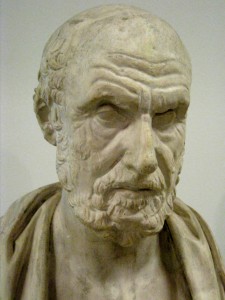
IN at least one source (a booklet from 1899, written by a pharmacist named Knufman) one can read that the first application of homeopathy is the case of the Greek king Telephos. In Greek mythology Telephos was hurt during the preparations for the Trojan war, by the spear of Achilles. Supposedly he was only cured after Apollo advised to treat the wound with some rust from Achilles’ spear. This of course predates Hippocrates, but it is not certain that this story reflects effective clinical practice.
Hippocrates founded medical ethics. In his opinion, patients must be able to trust physicians, and physicians in their turn must be worthy of that trust. They must be careful and competent, help where possible or at least not hurt. They may not use the methods of quacks, among which untruthful propaganda. In the eyes of Hippocrates diseases have natural causes, and supernatural cures are nonsense. Medicine must rely on careful observation.
In the beginning of the nineteenth century a patient usually was lucky if he or she could stay out of the hands of doctors. Medical treatments (poisons and bloodletting) were often very unhealthy. Hahnemann introduced three improvements in medicine, namely a thorough anamnesis, monotherapy and medical nihilism. In other words, the idea that one should administer to a sick person just one drug in a carefully measured dose, and preferably nothing material at all is Hahnemann’s. The third idea (not giving any medicine) was practiced a century later by Ernst Schweninger, but it is still not very popular with patients and pharmaceutical companies, and sadly, neither with many followers of Hahnemann.
Hahnemann proposed the Similia principle. That says that to cure a sick person, one should look for something that provokes similar symptoms in healthy people. This, preferably diluted, will cure the sick person. Hahnemann supported his ideas by own observations and rather fanciful quotations of experiences of older doctors, which he took as proof that the ancients had sometimes been able to catch a glimmer of his truth. I cannot resist mentioning that something like the Similia principle, namely treating wounds caused by firearms by pouring boiling oil into them, was abolished by Ambroise Paré in 1537, much to the relief of many soldiers.
Hippocratic medication
Hippocratic writings comprise about 60 treatises, written by many authors. The most complete edition dates from the nineteenth century: ten volumes of Greek text and footnotes, index and French translation. There is nothing about the Similia principle in it. In the Hippocratic view diseases are caused by too much or too little heat, cold, moisture, dryness. Intestines are to be cleansed by hellebore. That is: the roots of the Christmas rose or of Veratrum (a kind of lily), strong poisons that make the patient vomit or get diarrhea so quickly that the patient often survives the treatment. For many centuries these ‘natural medicines’ were used in combination with barley soup, wine, honey and vinegar. Alum, saltpeter, oxides of lead and copper were used to ‘dry out’ wounds (stop suppuration). In case of too much moisture, garlic, onions and leek were used (among others), as diuretics. Women with halitosis were recommended to brush their teeth with burnt rats and hares mixed with powdered marble. Burns were to be treated with chopped oak roots boiled in white wine, or with ointments that had fat and loam as chief ingredient.
Many Hippocratic writings do not contain any specific medicines, and treatments usually compensate the surmised lack or surplus of heat or moisture.
Two Hippocratic texts
Hahnemann quotes a passage from Peri topoon toon kata anthroopon (The places in man), that runs as follows (my translation).
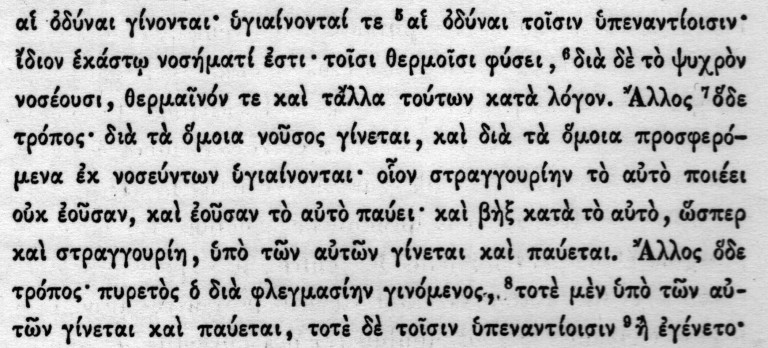
Pains become healthy by opposites; for every disease there is something proper; so, for what is warm by nature, but sickened by cold, there is something to warm it up, and so on and so on. This is another way: by similar (homoia) matters a disease arises and by administering similar things they regain their health from sickness; for instance the same (to auto) causes stranguria (i.e. difficult and painful urination) that wasn’t there before, and when it is there, the same will make it stop; likewise coughing arises, like stranguria, and it stops by the same things (hupo toon autoon). The fever caused by flegmasia (too much moisture) appears and disappears at one time by the same (hupo toon autoon) and at another time by the opposite of its cause.
An analogous quote stems from the treatise about the Sacred Disease, Peri hierès nousou. The Sacred Disease is anything that can cause fits, delirium, shiverings and foaming about the mouth, like pneumonia, epilepsy and many traumas of the brain, including strokes, tumors and wounds. By the way, asthma and ‘sacred disease’ are both caused by too much prenatal slime, the difference is that in asthma it goes to the lungs, and in ‘sacred disease’ to the brain. At the close of the chapter we find:
Each [disease] has its characteristic nature and force and none is intractable and hopeless. Most cases can be cured by the same things (tois autoisi) as what cause them. Because one is food for the other, but for something else again damage. So it is necessary that the physician knows how he, when he notices the critical moment, in each case [of sickness] will give nourishment to one and fortify him, and not give it to the other and weaken [the disease].
In this disease as with others, it is necessary to not increase the disease but tire it out quickly by applying the most inimical to it, and not [give it] something fitting that it is accustomed to.
Exegesis
I will try to explain these quotes, with the support of (among others) Joseph Schumacher (professor in the history of medicine).
Hippocrates merely says that depending on circumstances something can increase or decrease a disease. For instance stranguria (an affliction of a warm organ) is sometimes caused by heat (inflammation) and sometimes a warm bath is a good treatment. Maybe the passage also means that the same disease can have causes A, B etc., and that fighting cause B may consist of treatment with A.
What is the cause of coughing? In Peri Fysoon (Winds) we find that winds can disturb the circulation of fluids in the head, and these fluids will come out at all kinds of places, for instance snot that flows into the lungs and causes coughing, thereby inflammation of the throat. The throat attracts moisture because it becomes warm. In other words: coughing is caused by too much bad moisture on the wrong place. And it is cured by warm baths and drinking more fluid. So this is a case of driving out bad fluid by good fluid, not of a therapy that would cause coughing in healthy people.
Similarly too much food can cause intestinal trouble for a weakened person, in those cases food is still the best cure. The doctor should judge in each case separately whether to treat diarrhea with fasting or with food. In all cases the physician must know the deeper cause of the disease.
Some people think that ‘homoios’ and ‘autos’ merely means ‘fitting’, ‘of the same kind’. So the first quote above merely says that cause and remedy belong to the same class. If the cause is ’too hot or too cold’, the remedy must be of the same kind; wounds however need surgical treatment and the result of wrong food should be solved by diet.
Three more quotes
The early editions of Hahnemann’s Organon refer to a passage from Epidèmioon to pempton (Epidemies V). It is about a man who vomited and also had severe diarrhea (cholera?). This man was treated with hellebore, in combination with lentil water and washing of his underbody. Then he recovered. An ordinary Hippocratic cure: lentil soup is purifying, and hellebore likewise is supposed to drive out evil substances. So Hahnemann thinks that this unfortunate Athenian was cured by the hellebore rather than in spite of it.
In the book about internal diseases (Peri toon entos pathoon) a description is given of dropsy caused by drinking a lot from a pool of stagnant rainwater during a long walk. Part of the recommended treatment is letting the patient drink still more of the same water, to upset his intestines and cause ‘evacuation from below’.
Finally, the appendix of Peri diaitès oxeoon (Diet with acute diseases) says: ‘garlic causes flatulence, warmth in the breast, heaviness in the head, discomfort, increase of chronic pain, but the good thing is, it increases urine. The best moment to eat it is when one is going to drink a lot or is drunk [already]’ Now you may wonder what this has to do with the Similia principle. It seems some homeopaths explain this as follows: drinking causes a hangover, garlic causes headaches, hence the advice ‘garlic for drunks’ shows that Hippocrates applies the Similia principle. I think it merely shows that some homeopaths can’t read, because the text certainly doesn’t indicate any conscious application of the Similia principle, and whether garlic is beneficial to drunks is doubtful; if it’s really a diuretic one would think it makes a hangover worse rather than better.
Conclusion
The claim that Hippocrates applied the Similia principle is just as tenuous as the proposition that Shakespeare (’to be or not to be’) is the founder of existentialism. Actually, the passages say that a doctor should not only look for symptoms, but also for deeper causes. That contradicts the homeopathic method of looking for many symptoms of doubtful relevance.
Hahnemann’s merits do not lie in critical analysis of old texts. His followers treat his words as if it were some kind of holy writing. The mindless and careless copying of quotations out of context are the hallmark of pseudoscience and occult nonsense. And the proposition that Hippocrates has anything to do with homeopathy is just untruthful propaganda.
Note for the Skepsis-site
This is a summary of a somewhat longer Dutch article written on the occasion of a pamphlet distributed by the Royal Dutch Association of Pharmacists (KNMG), intended to provide objective information about homeopathy. Among other things it repeated the Hippocratic lie. Neither the Dutch, nor the English version has been published before. [Dutch version published December 2015 on the Skepsis Blog: Hippocrates was geen homeopaat!]
Literature
- Samuel Hahnemann, Heilkunde der Erfahrung. In: Kleine medicinische Schriften. Gesammelt und herausgegeben von Ernst Stapf, Zweiter Band, In der Arnold’schen Buchhandlung, Dresden und Leipzig, 1829. Originally appeared in: Journal der practischen Arzneykunde und Wundarzneykunst (Hufeland’s Journal), vol. 22 (3), 1805.
- Samuel Hahnemann, Organon der Heilkunst, Zweite Auflage. In der Arnoldischen Buchhandlung, Dresden, 1819.
- Hippocratic Writings, G.E.R. Lloyd (ed.), Translated by J. Chadwick and W.N. Mann, Penguin Books, London etc., 1983.
- Oliver Wendell Holmes, Homeopathy. In: Examining Holistic Medicine, Douglas Stalker and Clark Glymour (ed.), Prometheus Books, Buffalo, New York, 1989, p. 221-243. Originally two lectures from 1842.
- Emile Littré, Les œuvres complètes d’Hippocrate, traduction nouvelle avec le texte grec en regard (10 vols.), Paris, 1839-1861. Fotomechanical reprint Adolf M. Hakkert, Amsterdam, 1979.
- Arthur Lutze, Samuel Hahnemann’s Organon der Heilkunst, Sechste Auflage, Verlag der Lutze’schen Klinik, Coethen, 1865.
- Guido Majno, The Healing Hand. Man and Wound in the Ancient World. Harvard University Press, 1974.
- Joseph Schumacher, Die Anfänge abendländischer Medizin in der griechische Antike, W. Kohlhammer Verlag, Stuttgart, 1965.