Treat the leg or pull it?
Herniated disc treatments of miracle doctor Bonati
by Dick Zeilstra – Skepter 13.1 (2000)
Supplementary information about Bonati
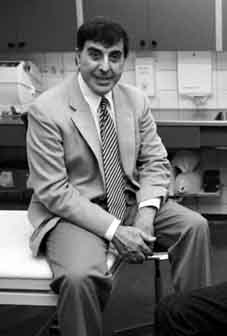 Dr. Bonati recruits patients in the Netherlands and Belgium for his American private clinics. He charges exorbitant amounts for the treatment of herniated discs by laser, a method without scientifically proven value.
On April 2, 1997, triathlon athlete Martin (not his real name), aged 40, went to get a pack of butter from his refrigerator. Suddenly he felt something snap in his back and he lost control of his legs. From the local hospital he was transferred to a center that was equipped with an MRI-scanner. The symptoms resembled those of an acute herniated disc, but the scan showed nothing abnormal. Martin and his neurologist wouldn’t give up and asked for another scan. But again nothing could be found, and the conclusions remained unchanged even after the expert opinion of a second radiologist.
Some time later the local newspaper Zwolse Courant of the region around Zwolle in the Netherlands wrote about Martin. A certain dr. Bonati in Florida would treat his intervertebral discs. It would cost about $35.000, which was raised among his colleagues. Altogether the Zwolse Courant published five laudatory stories about Bonati and his treatment until the end of January 1998, without any critical remark.
For example in the special New Year’s Eve section of the newspaper Martin told the newspaper: ‘In Bonati’s clinic they were flabbergasted that the people here in the Netherlands weren’t able to see anything on the MRI-scans. On copies of the scans that were made shortly after the event in Zwolle he (i.e. Bonati) could see exactly what was wrong. It was a bit hard to see, yes. But if they had intervened immediately, I would have been completely fit again within a few days.’
Martin apparently thinks that people who have interpreted his scans have made a professional mistake. He approached his insurance for legal damages, but nothing has been heard from them yet.
Supervision
Bonati treats intervertebral discs by a method which (as far as we can tell) involves inserting a laser fiber through a thin tube or a needle into or near to the intervertebral disc. By itself this is a regular treatment, which is sometimes used in the Netherlands and elsewhere in the world. Sometimes, because the results are dubious. Bonati has very unorthodox opinions and he treats patients that specialists in the Netherlands see as hopeless cases anymore. Bonati thinks of himself as a pioneer and he feels that his professional colleagues unjustly fail to appreciate his merits.
On his website (www.bonati.com) he advertises himself with a long list of memberships and publications. But anyone who takes the effort to investigate a little notices strange things: the Arthroscopy Board of North America, of which he is ‘President Elect’, is untraceable. The same goes for the American Academy of Neurological and Orthopaedic Surgery, Sports Medicine and Surgery. Easy to find is the International College of Surgeons, but anyone can register there as member via the website. Bonati is not a member of the usual professional organisations: not of the American Association of Orthopedic Surgeons, nor of the North American Spine Society. Neither is he Board Certified, which means he is only allowed to work in private clinics. That is no problem for him, because he runs several clinics.
Bonati is rolling in money and lives extravagantly. Possibly because he is professionally restricted in the USA, he is expanding into Europe. One can obtain multilingual information about his treatments through his (Dutch) organisation Medag (www.bonati.nl). Medag also helps find the money for treatment, because whoever wants to be treated by Bonati must reach very, very deeply into his pockets. Often money is collected by organisations like the Rotary Club. In the Netherlands referrals to the Bonati Institute are are by a Dr. P.C. Peperkamp, a neurologist who used to work in ‘s-Hertogenbosch. Peperkamp is now a consultant in Eindhoven, and he charges excessively large fees to patients that are often desperate. Former colleagues of his have told me that he is quite interested in money and owns all kinds of corporations.
On the Internet there is, apart from his own website, more information about Bonati. He can be found in the archives of the St Petersburg Times (www.sptimes.com). There are several articles on charges about complaints and accusations, from ‘excessive billing’ to ‘unnecessary surgery’. The Florida Board of Medicine also knows Bonati. If you ask for it, you get copies of the whole file, 270 pages. Most accusations are dropped because of lack of evidence, but nonetheless the huge number of complaints provide some insight into the methods of the orthopedic surgeon. Fact is that he wasn’t allowed to work unless supervised from October 6, 1994 until two years later.
Lay talk
Bonati often comes to Europe, and then gives lectures for patients in the most prestigious hotel (Amstel Hotel) of Amsterdam. They converge on this abode like pilgrims, carrying their X-ray pictures and MRI-scans. I received an invitation myself for one of those lectures, this time in Antwerp in Belgium. I went there with a journalist of the Zwolse Courant, to get first-hand information about the ‘Bonati method’.
If you are a physician and you go to a meeting like that with the idea that you’ll get detailed information about the Bonati method, you quickly become disillusioned. The lecture was just some lay talk about herniated discs and narrowing of the spinal canal, larded with self praise and reproaches to colleagues who don’t want to accept his method. It’s typical of the attitude seen in pseudo-scientists who charge at the windmills of the Establishment. The content proper was more or less correct. It was almost the same as the information that every patient routinely receives prior to an operation. But nothing was said about indications, methods or results. Mention was made of a small group of patients with a succes rate of 90%, not unusual in this type of condition. The story became unbelieviable when Bonati said that he had never seen any complications. Implicitly he said however how that was possible: a certain kind of infection wasn’t an infection at all, according to him, so that didn’t count.
After the lecture Bonati avoided all discussion and left the room after giving succinct answers to two questions. The patients could consult him individually. A former police officer with leg complaints was told that the problem was in his knee cap. He doubted that because the knee cap had been removed during an earlier operation.
The Zwolse Courant published a report of the meeting, almost a full page with quite a few critical remarks about Bonati and his methods. Soon afterwards I received an arrogant letter from a lawyer’s office in Amsterdam, demanding rectification, ‘in an article as large as the original article’. Also I was summoned to sign a contract in which I would promise never again to say things that might displease Bonati on pain of a huge penalty. I sent the office a letter detailing my position and afterwards I never heard from them again.
Some time before this legal advisor and physician E.H. van Strien had written an article about Bonati for the Dutch Institute of Claim Settlers. For this article he had visited a Bonati meeting in the World Trade Center of Amsterdam. At he end of an extensive report about the different methods of treating herniated discs, van Strien concludes:
- In the (Medag) ad it is said that specifically ‘back patients who cannot be treated anymore’ are eligible for treatment in The Bonati Institute. Remarkably all literature shows that all researchers [of endoscopic laser treatment] excluded patients that had already been operated on.
- Supposedly whiplash patients are eligible for this (the endoscopic laser treatment), but this is not supported in the literature. I have not seen anywhere in the literature that endoscopic laser treatment can be indicated for whiplash. One might ask what it is that needs lasering in a whiplash patient, because in such a patient only the soft parts are damaged.
- All authors write about their very strict selection criteria (also indicated by Bonati), so it is implausible and incomprehensible why trauma victims are eligible for this method.
- Supposing the endoscopic laser technique would be indicated in a trauma victim – e.g. in a posttraumatic herniated disc – it is not clear why these people only can be treated in the USA. The treatment is also available in Europe.
- Almost all writers indicate that the treatment is less expensive than a conventional surgical treatment. A surgical treatment, including preoperative examination and postoperative care, in the Netherlands would cost about 6,800 euro. I observe that this is very different from what The Bonati Institute charges, namely $20,000 to $40,000.
- Neither the presentation of Bonati nor the information contained in the advertisement or the brochures have been able to convince me of the special use for the treatment of trauma victims. (Kennis nr. 2, April 1999)
‘Idealistic motives’
On two meetings in the USA I had the opportunity to speak with colleagues about Bonati. Orthopaedists from Florida at first didn’t seem to know his work, but that was because they didn’t see him as a serious colleague. In fact they knew him very well. A neurosurgeon of the University of Tampa (Florida) had seen many patients that had passed through Bonati’s hands. One female patient had been operated on 23 times. Each time Bonati sticks a needle into an intervertebral disc (often the same, once from the right and once from the left) he charges $10,000. This colleague said literally: ‘I am ashamed that such a thing is possible in my country. This isn’t ordinary quackery, but borders on the criminal.’
Bonati charges a lot of money for a method of at least doubtful use. He has never published his results or reported them at the usual medical congresses. On Medag’s website we can read why: ‘Publication of scientific research is expensive and very time-consuming. For this, Dr. Bonati has decided to devote his time and means to treating patients and continuing to improve his succsess [sic] rate.’
If you wonder why such a treatment cannot be done in Europe, the answer is: ‘It appears that in Europe there are less economic incentives to introduce new methods of treatment and/or medicines. The US market, which is guided more by economic principles, is more inviting for investors and for the search for new medical treatments than here. It is now possible for European patients to use these innovative techniques, even before, sometimes long before they become available on the European market.’
Even Peperkamp recognizes that Bonati’s treatments are extremely expensive. But Bonati doesn’t care about money. His motives are idealistic: ‘Dr. Bonati is European by birth, and during one of his European holidays he saw the miserable state of many patients here, hence his decision to treat also European patients, but with sufficient support [i.e. Medag] for the European patient.’
[Note for this translation: the last two quotes are translated from the Dutch version on the website; the English version is somewhat more restrained: neither European market, nor miserable European patients there.]If you have been able to keep dry eyes until now, I must add that Bonati has appearances against him, because of his methods. Anyone who is truly innovating, simply has a burning desire to let his professional colleagues share his discoveries. But Bonati avoids all discussions about his methods and tries to stifle his opponents by setting lawyers on them. His fees are high, not only by Dutch standards, but they are excessive by USA standards as well. It is very unusual to recruit patients in expensive hotels. In the Netherlands that is considered unethical. Bonati avoids a scientific discussion, and seeks publicity in the press and on the Internet, so he shouldn’t be surprised if he is attacked in the same manner. Unfortunately not much else can be done about it.
Supplementary information about Dr. Bonati
Attempts to shut me up
In 2000 I was called by a man called Henk Schorel, a Dutchman from Malabar, Florida and Vice President of Broadcast of Advanced International Communications. He claimed to have been involved in a well known Dutch medical TV program and was now doing a series for the Florida audience. He wanted an interview with a medical specialist and asked if I would be willing to participate. It struck me as very odd that I was singled out for this purpose and the Florida origins of the filmmaker aroused some slight suspicions. I had no real grounds to refuse however and consented.
One Friday afternoon Mr. Schorel, accompanied by a cameraman, sound technician and female director set up his equipment in my office and started the interview. He inquired about my training and career, but very soon centered on Bonati, his techniques and what I thought of him. With Bonati’s army of legal advisors in mind I of course did not commit myself to any statements that would bring this army into action. After the interview I was promised a copy of the video tape. It was no surprise that I never received this. I sent a fax to two different fax numbers provided by Schorel on his business card, all to no avail.
The website (www.tvforinternet.com) also appears to be out of business. I have the impression the whole thing was setup to elicit some comments from me upon which legal action could be undertaken.
In 2001 I received a phone call from someone asking if I would be willing to engage myself in a forum with Bonati. My response was that as long as Bonati does not publish his results in a fashion open for scientific scrutiny the discussion would be no more that a yes-no affair. Shortly after that I received a rather unpleasant letter from a PR bureau criticising my views of Bonati’s methods and between the lines threatening legal action once again.
Starving for Bonati
In 2000 Bonati came in the Dutch news because of Mars Dieks from Eindhoven, who wanted his insurance to pay for treatment in Florida. Dieks had earlier been examined in Amsterdam by Bonati and Peperkamp. They thought that two small operations under local anaesthesia could relieve his chronic back ache, from which he had suffered ever since a motorbike accident in 1977. Total cost would be about 45,000 euro. The public health insurance did not want to pay. Dieks became very angry and went berserk in the Eindhoven office of the insurance company. In the end of January he went on a hunger strike and sued the insurance company. During the court session the lawyers of the insurance company said that they didn’t want to pay for the laser treatment as long as the members of the profession aren’t convinced of the value of the method. The insurance company won, but Dieks appealed in April.
[Addition for this translation: Later, in November, Bonati decided to treat Dieks for free. Even while the endoscope was being inserted Dieks felt the pain melt away. His memory improved too, because his bike accident is now reported to have been in 1974. Dieks promised to pay Bonati when he could get the money from the insurance. When he returned he was very happy with his cure, but otherwise angry with all those who had treated him unjustly. Sceptical people wonder if such a sudden improvement might not suggest a psychological rather than a physical cause for his complaints. Any local faith healer might have achieved the same, also for free.]Dr. Bonati strikes again
The laser treatments of the American miracle doctor are exorbitantly expensive. The treatments are doubted by the experts and Bonati himself doesn’t publish anything about his methods and results (see main article). Nonetheless there are still credulous people who are prepared to bring great sacrifices to be able to submit to the supposed miracle treatment.
A Dutch woman recently spent $200,000 with Bonati, almost enough to extend the fleet of the extravagant doctor with a new Lamborghini. She had already been operated on for a narrowing of the vertebral canal in the neck, and Bonati thought he could add something by lasering a number of intervertebral discs. This is a procedure that is completely useless in this situation – not even worth the effort to try whether the benefit of the doubt is justified.
The woman sold her house and some other possessions to pay Bonati’s bill. Only her wheelchair she was unable to sell, because she still needed it as much as before.
Meanwhile the website www.bonati.nl is recruiting new patients again for a consult of Bonati, who is visiting the Netherlands several times a year. It is deplorable that such practices are so hard to combat.
Dr. Bonati charged
Dr. Zachariah, a member of the Board of Medicine in Florida, wasn’t mincing words in the beginning of June 2000: ‘This is one of most outrageous cases I have ever seen. Bonati is uncurably dishonest. He is a grave threat to the people.’
Zachariah based his comments on a report of the health inspectorate, which had collected information about 21 patients that had submitted to unnecessary, useless and sometimes harmful treatments, mostly after they had been falsely informed. Also Bonati had charged demonstrably too much in some cases, and also he hadn’t correctly recorded the medical data of his patients.
Bonati has been charged several times before. He was reprimanded and in 1996 he was one year under the supervision of a physician who should check on him. This time the inspectorate proposed to fine him $100,000 and have him supervised for two years. The Board of Medicine however unanimously preferred to annul his licence permanently.
This case will be brought before an administrative judge. If Bonati is found guilty, this judge can recommend a punishment. After that, the Board of Medicine has the last word, but usually it follows the recommendations of the judge.
Critical articles about Bonati from the St. Petersburg Times:
Translated from Laseren of belazeren – De herniabehandelingen van wonderdokter Bonati, Skepter 13.1 (2000)